January 13, 2023
Anton Adasinsky played the villain in “Grom: A Difficult Childhood.” He is a legend of world theater!
You’ve definitely noticed this anti‑hero in the prequel to “Major Grom.” The colourful sidekick of the antagonist Anubis, the infernal jester known as Glashatay, looks like a performer from an avant‑garde troupe—and that’s exactly what he is. We’ll tell you in detail about the legend of Russian experimental theatre, which has long been appearing on screen and on stage in the sinister guise of demons of all calibres.
The hero of the era of performance art
"Thunder: A Difficult Childhood"
The 1990s, from a political and media perspective, are associated with, say, the fearless (and later murdered) journalist Vlad Listyev and the creator of financial pyramids, Sergei Mavrodi (who ran for president); both of them appear in the film. And the culture of that time is a wave of frenzied nonconformism. With the collapse of the USSR, an explosive wave of interest in various performances and actionism begins. The art group E.T.I. uses their bodies to spell out a word that is currently banned from publication (there were no bans on profanity in the media); naked and crawling on all fours, Oleg Kulik pretends to be a dog and attacks visitors to the gallery on Yakimanka; the AHE theater conducts alchemical experiments and mysterious rituals on the streets of Leningrad‑St. Petersburg. The interest in everything paranormal, parapsychological, and magical, which emerged among Soviet people as early as the 1960s (ufology, Bigfoot, Juna), is intensifying incredibly: while Allan Chumak is charging water on the TV screen, artists, directors, and performers are rushing to break free from the bounds of ordinary logic and human experience. On the theatrical stages, texts by the Obériuts and futurists are being performed at full force. Sergei Kuryokhin’s “Pop Mechanics” appears on television with banners reading “Burliuk,” which literally articulates its own connection to the Russian avant‑garde tradition that was interrupted during the Soviet era (prior to that, it had been revived by the St. Petersburg “New Artists”; their leader, Timur Novikov, received the title of Chairman of the Earth, which was once held by Velimir Khlebnikov). Non‑systemic art is emerging from the underground into the mainstream. And the performances of Anton Adasinsky, who is unlike anyone else and yet capable of resembling anyone, are of particular value to witnesses of the era.
Russian buto
In a sense, Adaminsky began performing as early as the 1980s. Vyacheslav Polunin invited him to join the first lineup of the Leningrad clown group “Litsedei.” According to him, the roles were distributed as follows: “Anton [Adaminsky] — tough, Valera [Keft] — inspired, Lenya [Leikin] — the laugh‑maker, Papa [Robert Gorodetsky] — the intellectual, and so on.” At the same time, the tough clown meets Boris Ponizovsky, the Leningrad athlete of experimental theater, the inventor of masks, and a theatrical philosopher. And all of this happens during the golden era of the Leningrad Rock Club: Adasinsky meets Tsoi and Grebenshchikov, plays all sorts of instruments, and joins the band “AVIA” as a musician, vocalist, and… stage director. By the way, recently, as if paying tribute to that golden era, Adasinsky appeared in Tsoi’s biopic “Leto” by Kirill Serebrennikov (he played a cameo role as the owner of the apartment where the underground concert takes place). At that time, in the 1980s, clowning, rock and roll, and underground experimental theatre laid the groundwork for the emergence of Adasinsky’s original theatrical punk technique, which the stunned European audience would call “Russian butoh.”
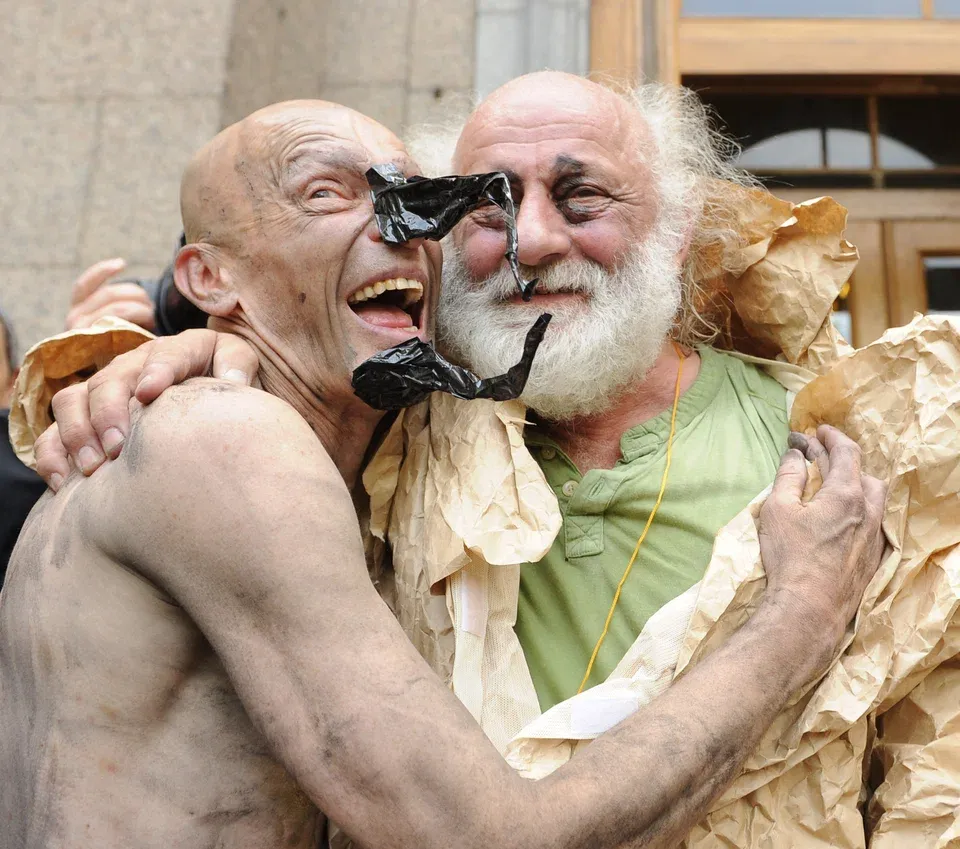
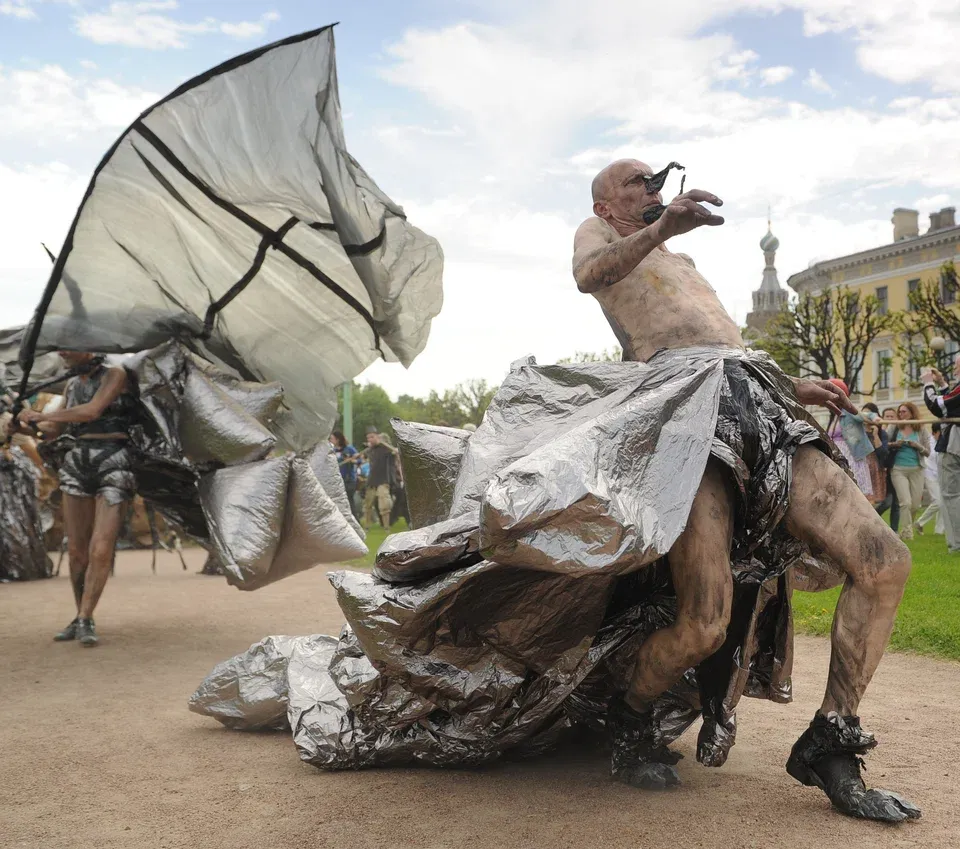
Anton Adasinsky and Slava Polunin during a performance near the Marble Palace of the Russian Museum, 2013.
“A depraved child has special abilities for butoh,” Tatsumi Hijikata asserted. “Because he knows how to create beautiful studies.” This quote became the epigraph to one of the first major articles about the Derevo theatre, published in Russian in the June issue of the magazine “Rodnik” in 1990. But Adasinsky always insisted that Japanese butoh and what he was doing were not exactly the same thing. “There is something on our land that they don’t have.” There is the concept of a “holy fool.” Anything goes with him; he says whatever he wants. He is allowed to do so because he is a link between the higher powers and humanity.
Tough creative methods
To turn one’s consciousness upside down, to give it a good shake, to knock the mechanism of perceiving the world out of its well‑trodden rut of automatic thinking — this is Adasinsky’s method in working both with the public and with students. “I studied at a theatre academy in St. Petersburg, attended classes, performed in plays at the Youth Theatre and at the Lensovet Theatre, appeared in some TV series from time to time, and worked as a clown at children’s birthday parties,” says theatre director Maxim Didenko. “Once, Anton was giving a lecture at the theatre academy illegally.” He talked about a different way of looking at the world, in principle. In this perspective, everything I had lived by was subjected not just to doubt, but to a rather humorous refutation. And then my friend Roma Gabriia and I caught up with Anton on the street and asked him to join us for a master class. It was a tough master class, during which Anton led us through exercises that radically expanded the boundaries of consciousness and physicality to such an extent that all my doubts about the system in which I existed were simply washed away. I realized then that what I’m currently involved in is what I want to do for the rest of my life. And I’m still doing exactly that. Today, Maxim Didenko is one of the most sought‑after Russian theatre directors in Europe, famous for his energetic horror‑dances based on the texts of Kharms, Pelevin, Sorokin, and Babel. These days, for example, his major premiere is being staged at the Gorky Theatre in Berlin — The Last Word.
When, in the play “The Last Clown on Earth,” Adasinsky dances his own unique dance at the limit of endurance, when his slender body convulses, and his arms, legs, and head swing as if on hinges, then along with the rigidity, one can feel vulnerability and fragility. The helplessness of a marionette in the hands of a deranged puppeteer. The concept of the actor‑puppet was popularized a hundred years ago by the great theatrical reformer Vsevolod Meyerhold. It is only natural that it was Adasinsky, one of the most persistent followers of the forgotten masters of the theatrical avant‑garde, who played the role of Meyerhold in Alexander Shein’s film “VMayakovsky” (2018). On stage, Adasinsky resolutely ceases to be himself. But on screen, he is not the same as on stage. In cinema, he is invited precisely to play himself. Due to his shaved head and particular composure, “tough Anton” may look like someone for whom prison feels more like home than freedom, and the creators of “Grom” specifically tapped into this aspect of his stage persona.
Play the devil for us
"Faust"
Both the image of time standing still and the theme of madness, as well as nostalgia for the wild 1990s — all of this is no longer a field for cultural reflection today, but an everyday reality. It seems that for Adasinsky, the creator and proponent of an ascetic, brutal theatre born of the element of chaos, the relatively calm 2000s and 2010s in Russia were not a completely natural environment for him. In it, he would quickly transform from a punk into a sought‑after choreographer for fashionable stages and festivals. But perhaps now, when the space for artistic expression has narrowed to almost Soviet‑like proportions, the veterans of the underground will once again be able to breathe freely.
Adasinsky in the performance by the group Derevo. Dresden, 2017.
One can either share or not share this enthusiasm for the stormy petrel Adasinsky. But it’s hard not to be glad that among the veteran stage performers, in addition to well‑meaning loyalists like Oleg Menshikov and, say, Dmitry Pevtsov, there is this kind of devil from the box who is true only to himself.
 .
.